Nothing remarkable has happened in Harare so far. I was very fortunate in finding that the 2011 Harare Book Festival was taking place while I'm here. I spent a couple enjoyable hours talking with folks at the fair about how teachers are trained in Zimbabwe; how black farmers are faring now that they've been given land seized from white farmers; the state of literature in Zimbabwe (I bought three books for my classroom library by Zimbabwean authors); and the state of libraries in Zimbabwe (I agreed to try to send some books to help the cause).
Most of my time has been spent wandering around Harare, learning the layout of the city. I've ridden some more omnibus commuter buses into the suburbs, always an interesting thing to do. I've been searching for the best way to get to Botswana from here. It turns out the cheap buses leave from a crowded suburb called Mbare and that I'd need to get there at around one a.m. to secure a seat on the 6am bus. It sounds dangerous. So I'm going to research whether I can take a luxury bus from the city center to Bulawayo (remember Bulawayo, my favorite city of this trip), then transfer to a bus going further south to Botswana. We shall see.
I've been pondering several questions about Harare and Zimbabwe:
1. Why are there no Chinese restaurants in this country? I can't remember the last nation I've been in where there were none. And I know, from reading the local press, that there are many Chinese in Zimbabwe either mining minerals or searching for new deposits. In fact that is a controversial topic hereabouts. The MDC people (the major party opposed to Mugabe) resent the Chinese, saying they are raping the country of its mineral wealth. (Most of the refining apparently happens in China). Yet somehow all those Chinese workers are keeping a low profile. I saw my first two Chinese folks on the streets this morning. So why no restaurants.
Zimbabwean cuisine is the worst in the world, I'll wager. Every restaurant serves the same fare: chicken and rice; beef and rice; some other meat and rice; chicken, beef, or other with chips (french fries). And I am not exaggerating. No one sells anything else. If you are very lucky someone will serve a salad with the aforementioned. There is one chain of 'restaurants'. They have four incarnations, Baker's Inn (baked goods); Chicken Inn; Steer Inn (hamburgers); and Creamy Inn (Ice cream).
1a. Related to this is the question of indigenisation. This is a new law requiring that all foreign mining operations sell 51% of their assets to Black Zimbabweans (most of whom would presumably belong to Zapu PF, Mugabe's party). One assumes that many of these firms belong to the Chinese, yet I've read nothing in the press indicating that the Chinese embassy or any representative of Chinese business firms is upset.
2. Why are there no motorcyles or motor scooters in Zimbabwe? I've seen two motorcyles (one a nice offroad bike near Masvingo) and not one motor scooter. There are automobiles. Thousands of them in Harare. The omnibuses amount to thousands of vehicles all by themselves. So why no scooters?
3. The trash pickup system is odd. There are no streetside trash receptacle. Everyone simply throws their trash on the ground wherever they happen to be. Then a city employee comes and sweeps the trash into piles at intersections for sometimes mid-block. Generally these piles are set alite, where they smolder for hours. Occasionally a city garbage truck will come along and scoop up piles of trash from these piles into the trucks.
4. Why is it that in this terribly poor country (according to the press annual per capita income is $640; unemployment is 80%) everyone is scrupulously honest and friendly towards me? From my limited experience this is the most honest, friendly country I have ever visited, I almost didn't come here because I was afraid of robbery (or worse). What a mistake it would have been to give in to those fears.
Saturday, July 30, 2011

Thursday, July 28, 2011
July 29
Too tired to write much tonight. After studying my Lonely Planet I decided to head north to Harare. I found a nice hostel in an area with a lot of college students. No dorm available but I got a room for $25/night, a bit more than I anticipated but reasonable. I expect to stay here three or four days.
The bus ride from Masvingo was tight; we were crammed in like chickens one of those assembly lines that animals rights folks are always citing. I have the sore back to prove it. Luckily an old man decided to be my guide, without my asking, and he even helped me find the right neighborhood in Harare once we got here. What little I've seen of the city does not endear itself to me, but we shall see.
The bus ride from Masvingo was tight; we were crammed in like chickens one of those assembly lines that animals rights folks are always citing. I have the sore back to prove it. Luckily an old man decided to be my guide, without my asking, and he even helped me find the right neighborhood in Harare once we got here. What little I've seen of the city does not endear itself to me, but we shall see.
Wednesday, July 27, 2011
July 27
Today I spent several very enjoyable hours traveling to--and exploring--The Great Zimbabwe, largest archeological ruins in Sub-Saharan Africa. The ruins themselves are very reminiscent of Pergamum,  Greek ruins in Western Turkey. And within the entire 'city' is a fortress-like structure that could easily be mistaken for Troy. The story of the place is that a group of people from east of here, in present day Tanzania, migrated to this valley sometime in the 12th or 13th century (I can't remember which right now). They used granite blocks, which they shaped by first heating the rocks, then dousing them with water to fracture the granite structures. Like the Greeks they splayed the stones so that the lower wall was wider than the top. No mortar was used. Like Pergamum they perched a castle-like fortification on a nearby hill, and put the King's residence there. For six bucks I hired a guide who answered all my silly questions without complaint.
Getting to the ruins was half the fun. My hostel host told me if I hoofed it to a nearby college I could catch a minibus to the ruins. I followed her instructions but one part didn't work out as seemlessly as I expected. The van dropped me off near a dirt track. The driver pointed down the road and said, "Go that way." My first thought was about the warthog that had just crossed in front of our van a mile or two back. My second thought was, "is this guy taking the tourist for a (literal) ride, dumping him in some backwater from which I will never emerge?" But so far everyone in Zimbabwe had been straight with me so I set off through the underbrush to find The Great Zimbabwe. The 'road' was a dirt pathway that had been obviously created by many horsedrawn wagons traversing the ground. Two ruts were separated by some tufts of grass. I walked for a few minutes till I came to a fork in the path. Ahead was a farm house with a lady hanging wash. So I motioned to her. "Left?" I signified. She nodded. So I trod onward, avoiding the feces on the path (cow or baboon?). After a few minutes I came to another paved road. Which way, right or left? I guessed right and, shortly, I noticed bright colors in the distance. Those turned out to be a streetside crafts market. The market ladies shouted instructions to me ("Turn here. Go through the hotel, you'll find the park behind the hotel.")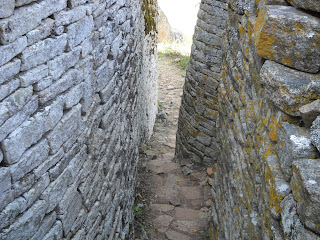
The ride home to my hostel was even better as I got a ride in the back of a covered pickup truck with an old man and a young girl going my way. The ride to the ruins was $2, the ride back was $1. Can't beat that.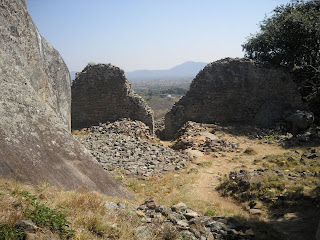
Masvingo, where I 'm staying now, is a small city with an air of commerce about it--unlike Bulawayo. It's not prosperous (the electricity is turned off each night at 4:30) but the stores are very clean, and dozens of young men are engaged in building a sewer system of sorts. Their jackhammers woke me at 5:30 this morning. Most of them are digging with picks and shovels. The sad part is that the sewer is intended to direct all the untreated waste into the city's river. The river is barely a quarter mile from town. And there is a nice crafts market just beyond the river. I can't imagine the stink that this will all bring to the neighborhood, not to mention the trash that will fill the river.
I'm really in a quandary about tomorrow. I could head north to Hararre, the Zimbabwean capital. There's a train from Hararre to my next destination, Gaborone in Botswana. But really there is nothing attracting me to the capital except that Zimbabwe has been such a pleasant surprise. I admit to getting a little tired of all the deprivations of this, very poor, nation. Botswana is likely to be more modern and comfortable. I will probably head south, instead, hoping to catch that same train in Bulawayo tomorrow afternoon. That would get me to Gaborone in two days. But that is really too early.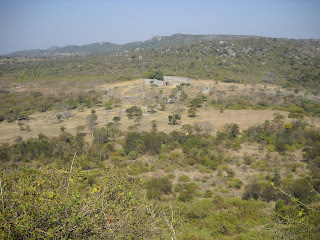 I'd rather get there on about August 2nd. I could head east to Mozambique, but transportation is so bad in Mozambique that I might never make it to Gaborone. Time to study my Lonely Planet.
 Greek ruins in Western Turkey. And within the entire 'city' is a fortress-like structure that could easily be mistaken for Troy. The story of the place is that a group of people from east of here, in present day Tanzania, migrated to this valley sometime in the 12th or 13th century (I can't remember which right now). They used granite blocks, which they shaped by first heating the rocks, then dousing them with water to fracture the granite structures. Like the Greeks they splayed the stones so that the lower wall was wider than the top. No mortar was used. Like Pergamum they perched a castle-like fortification on a nearby hill, and put the King's residence there. For six bucks I hired a guide who answered all my silly questions without complaint.
Getting to the ruins was half the fun. My hostel host told me if I hoofed it to a nearby college I could catch a minibus to the ruins. I followed her instructions but one part didn't work out as seemlessly as I expected. The van dropped me off near a dirt track. The driver pointed down the road and said, "Go that way." My first thought was about the warthog that had just crossed in front of our van a mile or two back. My second thought was, "is this guy taking the tourist for a (literal) ride, dumping him in some backwater from which I will never emerge?" But so far everyone in Zimbabwe had been straight with me so I set off through the underbrush to find The Great Zimbabwe. The 'road' was a dirt pathway that had been obviously created by many horsedrawn wagons traversing the ground. Two ruts were separated by some tufts of grass. I walked for a few minutes till I came to a fork in the path. Ahead was a farm house with a lady hanging wash. So I motioned to her. "Left?" I signified. She nodded. So I trod onward, avoiding the feces on the path (cow or baboon?). After a few minutes I came to another paved road. Which way, right or left? I guessed right and, shortly, I noticed bright colors in the distance. Those turned out to be a streetside crafts market. The market ladies shouted instructions to me ("Turn here. Go through the hotel, you'll find the park behind the hotel.")

The ride home to my hostel was even better as I got a ride in the back of a covered pickup truck with an old man and a young girl going my way. The ride to the ruins was $2, the ride back was $1. Can't beat that.

Masvingo, where I 'm staying now, is a small city with an air of commerce about it--unlike Bulawayo. It's not prosperous (the electricity is turned off each night at 4:30) but the stores are very clean, and dozens of young men are engaged in building a sewer system of sorts. Their jackhammers woke me at 5:30 this morning. Most of them are digging with picks and shovels. The sad part is that the sewer is intended to direct all the
 untreated waste into the city's river. The river is barely a quarter mile from town. And there is a nice crafts market just beyond the river. I can't imagine the stink that this will all bring to the neighborhood, not to mention the trash that will fill the river.
I'm really in a quandary about tomorrow. I could head north to Hararre, the Zimbabwean capital. There's a train from Hararre to my next destination, Gaborone in Botswana. But really there is nothing attracting me to the capital except that Zimbabwe has been such a pleasant surprise. I admit to getting a little tired of all the deprivations of this, very poor, nation. Botswana is likely to be more modern and comfortable. I will probably head south, instead, hoping to catch that same train in Bulawayo tomorrow afternoon. That would get me to Gaborone in two days. But that is really too early.
 I'd rather get there on about August 2nd. I could head east to Mozambique, but transportation is so bad in Mozambique that I might never make it to Gaborone. Time to study my Lonely Planet.
Monday, July 25, 2011
July 25
I wanted to visit the esteemed natural history museum in Bulawayo today. On my way there I chanced upon 'Centenary Park', Bulawayo's central park. It epitomizes this country and this city. The park has been here for over one hundred years I think. Certainly the trees are magnificent 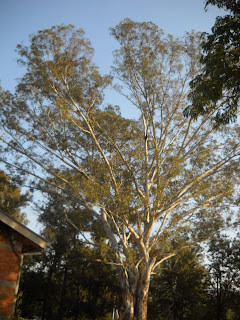 specimens, some over 100 feet in the air. You can see that once upon a time this was a stunning tribute to the city. But time and neglect have rendered it a relic. An old abandoned miniature golf course is at the park's center. There is the shell of a once impressive zoo including an aviary.
  An old locomotive was once used to take kids around a narrow gauge track within the park. The track is still here and the locomotive sits nearby. There are slides and beautiful walking paths. I saw one elderly man in a uniform gamely watering plants from a lone spigot. Very sad.
  This park needs a benefactor, someone to spend a couple hundred thousand bucks to revive a once great piece of this community.
After the museum I went in search of something from my Lonely Planet guide. The book showed an Arts & Crafts building on the outskirts of town where locals made and sold art work. I figured that would be a great place to buy a gift. I began walking out Sixth Avenue as my guide book instructed. Within about fifteen minutes I was outside the city proper in a residential district that looked very much like public housing projects all over the world. Block upon block of identical single and double story brick buildings lined my way. The homes were small with about 200 square feet of front 'lawn'. Most had trees out front, citrus and other fruit crops in the majority. A few had paved the front area with decorative stones or cement. Most merely had sand or a few small flowers. Most residents did their gardening on the side or out back where I saw many local veggies being grown.
I got lost, as usual, but was able to quick people on the street often enough that I didn't go far astray. As I neared my objective I was greeted by a flood of school children from a local primary school who were going home for the day apparently. I suspect that the school day here is short owing to the extreme heat that covers most of the school year. I tried to ask for directions from the kids but no one understood my English. Language is an interesting issue in Zimbabwe. There are three languages, Shona, Ndebele, and English. The latter is the official tongue and all store fronts are in English. Yet most people seem to speak the native languages. Last week there was a hullabaloo because some of Mugabe's backers wanted new constitutional changes printed in Shona as well as English. My sense is that this is a side issue that crosses party lines. Anyway, I am most surprised that no store owner has opted to put up Shona or Ndebele signs. Seems like a smart marketing move to me.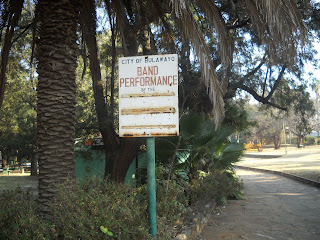
I found the Arts & Crafts place. There were two buildings, one for pottery (no good for me; too fragile) and one for other crafts. But, like most things in Zimbabwe in 2011, the crafts people have fallen on hard times. I found a small store with some basic basketry and weaving from which I was able to procure one gift. But I suspect if I'd been there twenty years ago I would have found a more robust facility.
Bulawayo is so reminiscent of Malatya, Turkey, a place I found two years ago. Each has a terrific museum. The Bulawayo Natural History Museum must be one of the finest in Africa. It has hundreds of rare specimens including one stuffed elephant reputed to be the second largest ever taxidermed. Each city also has an interesting archaeological site nearby: Malatya had Arsenteppe, a 6,000 year old dig dating to the Hittites. Bulawayo has the Great Zimbabwe, which I hope to visit tomorrow.
 specimens, some over 100 feet in the air. You can see that once upon a time this was a stunning tribute to the city. But time and neglect have rendered it a relic. An old abandoned miniature golf course is at the park's center. There is the shell of a once impressive zoo including an aviary.
  An old locomotive was once used to take kids around a narrow gauge track within the park. The track is still here and the locomotive sits nearby. There are slides and beautiful walking paths. I saw one elderly man in a uniform gamely watering plants from a lone spigot. Very sad.
  This park needs a benefactor, someone to spend a couple hundred thousand bucks to revive a once great piece of this community.
After the museum I went in search of something from my Lonely Planet guide. The book showed an Arts & Crafts building on the outskirts of town where locals made and sold art work. I figured that would be a great place to buy a gift. I began walking out Sixth Avenue as my guide book instructed. Within about fifteen minutes I was outside the city proper in a residential district that looked very much like public housing projects all over the world. Block upon block of identical single and double story brick buildings lined my way. The homes were small with about 200 square feet of front 'lawn'. Most had trees out front, citrus and other fruit crops in the majority. A few had paved the front area with decorative stones or cement. Most merely had sand or a few small flowers. Most residents did their gardening on the side or out back where I saw many local veggies being grown.
I got lost, as usual, but was able to quick people on the street often enough that I didn't go far astray. As I neared my objective I was greeted by a flood of school children from a local primary school who were going home for the day apparently. I suspect that the school day here is short owing to the extreme heat that covers most of the school year. I tried to ask for directions from the kids but no one understood my English. Language is an interesting issue in Zimbabwe. There are three languages, Shona, Ndebele, and English. The latter is the official tongue and all store fronts are in English. Yet most people seem to speak the native languages. Last week there was a hullabaloo because some of Mugabe's backers wanted new constitutional changes printed in Shona as well as English. My sense is that this is a side issue that crosses party lines. Anyway, I am most surprised that no store owner has opted to put up Shona or Ndebele signs. Seems like a smart marketing move to me.

I found the Arts & Crafts place. There were two buildings, one for pottery (no good for me; too fragile) and one for other crafts. But, like most things in Zimbabwe in 2011, the crafts people have fallen on hard times. I found a small store with some basic basketry and weaving from which I was able to procure one gift. But I suspect if I'd been there twenty years ago I would have found a more robust facility.
Bulawayo is so reminiscent of Malatya, Turkey, a place I found two years ago. Each has a terrific museum. The Bulawayo Natural History Museum must be one of the finest in Africa. It has hundreds of rare specimens including one stuffed elephant reputed to be the second largest ever taxidermed. Each city also has an interesting archaeological site nearby: Malatya had Arsenteppe, a 6,000 year old dig dating to the Hittites.
 Bulawayo has the Great Zimbabwe, which I hope to visit tomorrow.
Sunday, July 24, 2011
July 24
Sunday here in a very Christian nation so not much is open. I used the day to wander the streets and read the local press. Surprisingly Zimbabwe has one of the most vibrant presses in the world if my eyes don't deceive me. I'm especially impressed with the Zimbabwe Independent, a mouthpiece of the opposition but also one of the best newspapers I've ever encountered. Zimbabwean politics is fascinating. Mugabe has been president since 1980, another guy who stayed too long. (Insert praise for the redoubtable Nelson Mandela, who just passed his 93rd birthday). In 2000 Mugabe, for understandable reasons, decided to seize all the major farms from their white owners (who got the land under the apartheid-like regimes of the previous century). He abandoned a previous system of buying the land that was funded by Great Britain. The pace was, apparently, glacial. The result of the seizures, however, was chaotic, and self-aggrandizing for those close to Mugabe. They got rich, the country went down the tubes, now listed as the second poorest on the planet. Civil war ensued. It was mostly black against black with tribal loyalties involved. In 2008 a sort of truce was put in place that gave some power to the opposition. That compromise is still in place though this week's newspapers say that Mugabe has rigged up an alternate financing system using money from mining to skirt the regular government finance system.
Bulawayo is a hotbed of opposition and the local press is full of anti-Mugabe rhetoric. All you see on the streets is the end result, an impoverished population hanging on by a thread. Hyper inflation killed most people's savings in the 2000's. The country abandoned their devalued currency and replaced it with US dollars and South African rand. A big issue locally is the scarcity of US coins. This forces businesses to substitute barter for small amounts. Groceries routinely give candy as 'change', which gives opponents a ready source of outrage. About every third business in Bulawayo sells 'air time' for cell phones. Another big chunk sells cell phones and accessories. There are few restaurants in town and nothing that could be called an upscale hotel. Trash pickups are rare, I gather, and residents simply push it into alleys or available out of the way spots. The telltale smell of raw sewage hit me randomly as I walked the streets.
But what really stands out for me is the friendliness of everyone I've met. Waiters, minivan drivers, newspaper vendors, they all give me a big smile and go out of their way to help me. The guy who drove our bus from Vic Falls chased me down the street for two blocks to try to steer me to a good place to stay.
One of the places where European influence really shows itself here is in sports. The papers are full of news from the Premier League in England, and local athletes excel at rugby and cricket.
Yesterday, through the fog of fatigue, I forgot to relate the excitement of our drive from Vic Falls. The land from Vic Falls to Bulawayo is virtually uninhabited. All I ever saw were a few gatherings of thatched roof huts, mostly fewer than five in a cluster. And the roads were almost devoid of personal automobiles. Traffic was mostly buses and semi's hauling freight. It was not a stretch of highway to liven the heart of a hitchhiker.
So when, about 100k. out of Vic Falls, I heard the telltale noise of a muffler dragging under our minibus (a large one, holding about 30 passengers) my heart stopped. The van came to a slow stop in the middle of nowhere. When the driver turned off the engine I began calculating my chances of survival. Thirty people abandoned on the highway. Who would get the few rides available? Certainly not me. The next settlement was probably forty or fifty miles ahead, and even those places probably didn't have hotels or places for me to sleep. And what of the growling teams of baboons I'd seen crossing the road ten minutes ago? Sleeping beside the road was not an option.
There's no drama, here, of course, because I made it to Bulawayo. The driver snarled, then pulled out a rope. In a few minutes he was thrusting his coat on the ground under the chassis. Somehow he managed to tie up the muffler well enough to get us 300k. further down the road.
I plan to stay here a day or two more before heading out to the Great Zimbabwe.
Bulawayo is a hotbed of opposition and the local press is full of anti-Mugabe rhetoric. All you see on the streets is the end result, an impoverished population hanging on by a thread. Hyper inflation killed most people's savings in the 2000's. The country abandoned their devalued currency and replaced it with US dollars and South African rand. A big issue locally is the scarcity of US coins. This forces businesses to substitute barter for small amounts. Groceries routinely give candy as 'change', which gives opponents a ready source of outrage. About every third business in Bulawayo sells 'air time' for cell phones. Another big chunk sells cell phones and accessories. There are few restaurants in town and nothing that could be called an upscale hotel. Trash pickups are rare, I gather, and residents simply push it into alleys or available out of the way spots. The telltale smell of raw sewage hit me randomly as I walked the streets.
But what really stands out for me is the friendliness of everyone I've met. Waiters, minivan drivers, newspaper vendors, they all give me a big smile and go out of their way to help me. The guy who drove our bus from Vic Falls chased me down the street for two blocks to try to steer me to a good place to stay.
One of the places where European influence really shows itself here is in sports. The papers are full of news from the Premier League in England, and local athletes excel at rugby and cricket.
Yesterday, through the fog of fatigue, I forgot to relate the excitement of our drive from Vic Falls. The land from Vic Falls to Bulawayo is virtually uninhabited. All I ever saw were a few gatherings of thatched roof huts, mostly fewer than five in a cluster. And the roads were almost devoid of personal automobiles. Traffic was mostly buses and semi's hauling freight. It was not a stretch of highway to liven the heart of a hitchhiker.
So when, about 100k. out of Vic Falls, I heard the telltale noise of a muffler dragging under our minibus (a large one, holding about 30 passengers) my heart stopped. The van came to a slow stop in the middle of nowhere. When the driver turned off the engine I began calculating my chances of survival. Thirty people abandoned on the highway. Who would get the few rides available? Certainly not me. The next settlement was probably forty or fifty miles ahead, and even those places probably didn't have hotels or places for me to sleep. And what of the growling teams of baboons I'd seen crossing the road ten minutes ago? Sleeping beside the road was not an option.
There's no drama, here, of course, because I made it to Bulawayo. The driver snarled, then pulled out a rope. In a few minutes he was thrusting his coat on the ground under the chassis. Somehow he managed to tie up the muffler well enough to get us 300k. further down the road.
I plan to stay here a day or two more before heading out to the Great Zimbabwe.
Saturday, July 23, 2011
July 23, I think
I spent the day motoring from Livingstone, Zambia to Bulawayo, Zimbabwe. I learned never to invest in a used copy of Lonely Planet. It cost me today. I got to the Zimbabwe border this morning confident that there was no visa cost, but that was old info. I needed $30. So I had to backtrack to Livingstone, Zambia to get the cash. Luckily a kindly cab driver went out of his way to help me, even to the extent of finding friendly money changers, so it all worked out just fine. Once across the border I found a minivan headed to Bulawayo. It was an eight hour journey on a hard seat but I enjoyed it. I feel better being back on the regular bus lines and off the tours for a while.
I'm dead tired and haven't the energy for a long post. I had some trouble when I got here finding a bank that would take my ATM card (strange fact: the national currency of Zimbabwe is the US dollar) but eventually settled that. I also struggled to locate a good, cheap place to stay but that, too, is now old news. So I'm optimistic. I plan to stay here at least one full day before heading for a historical site called 'The Great Zimbabwe".
I'm dead tired and haven't the energy for a long post. I had some trouble when I got here finding a bank that would take my ATM card (strange fact: the national currency of Zimbabwe is the US dollar) but eventually settled that. I also struggled to locate a good, cheap place to stay but that, too, is now old news. So I'm optimistic. I plan to stay here at least one full day before heading for a historical site called 'The Great Zimbabwe".
Thursday, July 21, 2011
July 16 to July 22
I've been camping and out of touch for a week but it looks like I can post today:
July 17
Call this three degrees of separation from home.  The first degree is any foreign land. The second degree is the small towns and villages of the world away from some or all of the comforts of home. The third degree is to travel away from the villages into the hinterland, on a 4x4 truck, for instance, deep into the jungle or the desert. In this case it is something of both. Call this a dry swamp. Officially it is named the Okavango Delta, a confluence of rivers in northwest Botswana.
We got here by trucking for two days from Windhoek, east into Botswana. Most of this nation encompasses the Kalahari Desert, a vast land of acacia trees and thorn trees and low shrubs. Unfortunately, like many areas of Southern Africa, the ‘wildlife’ is more likely to be beef cattle than leopards or wildebeest. The habitations are traditional round huts of the Bush People. Every once in a while if you peer into the bush beside the highway you see a small collection of these huts. Their means of survival are few as far as I can see: goats, donkeys, and cattle. There isn’t enough water to sustain farming I don’t think. At least I saw no evidence of agriculture. 
If you hang a left somewhere inside Botswana and head north you come to the only non-arid territory hereabouts. But even here the vivid blue water is surrounded by white, white sand. It’s as if someone quickly superimposed a swamp onto a desert. To get to our campground we had to off load from our truck and board a ponderous 4x4 ‘bus’. We plowed through swampland for 40 minutes till we came to a beautiful resort on a wide expanse of the river.
My group this time consists of five tourists and two guides. Manni is the black Namibian leader of our expedition. Solidly built with a deep, authoritative voice, he is a perfect choice to guide us. His sidekick is Joseph, a younger, smaller version of Manni. They sit up front.
In back are the six of us. Marcus and Laura are Germans from Munich. He is a biologist working on vaccines. Irene is a middle-aged manager for Ska Travel headquartered in Melbourne, Australia. She is on a kind of busman’s holiday, checking out our tour company at the same time as getting some vacation time away from her family. Omer and Tom are from Jerusalem, at least now that is where they live. Tom grew up in Farmingdale, Long Island about ten miles from my hometown. They are in their early 50’s I’d guess with adult children back home.
Just as we were leaving Namibia I grabbed a newspaper. Inside was a revealing story about a group of lions formerly resident in northwest Namibia near the Angola border. In fact these lions were observed trekking across the border a few years ago and quickly fitted with collars for environmental study and in a vain attempt to keep the lions—and their human neighbors—safe.
It started with one male, one female, and a cub. Before long there were two males and several cubs, a total of ten lions in the group. Then someone got a license to hunt one of the males. It turns out that wildlife hunting is so lucrative that the Namibian government is willing to risk losing some of their tourist attractions to reap this bounty. For tens of thousands of dollars you can go on a sanctioned hunt, which someone did---though apparently there was some dispute about who provided the sanction and whether they had the right to do so. But the lion was killed. The theory is that if only males are killed you still retain females to bear the litters.
You can guess the rest of the story. In the wet season the four-legged delicacies that form the lion’s diet migrated elsewhere. So the lions began eating cattle and donkeys of the local folk. So some of the lions were shot. Then, last week, the last three lions were found poisoned. The need to protect livestock trumped the more abstract need to protect the tourist industry. How this will end I don’t know. Tourism is a very big business in Namibia. There is a high school in Windhoek that is set up to train young people for the various tourist vocations. But one hunt for an elephant reportedly yielded over $100,000 for a farmer last year.
My eleven-day tour so far has been dull. Out of five days so far elapsed I’ve spent four days being driven around in a large van. But it looks like the next six days will be more active. We shall see.
July 18
The sense that is most useful in the Okavango is hearing. People talk about how you can see so many stars when you are away from the glare of modern life but no one mentions that out here you can hear things that generally are obscured by the noise of crowded life. Last night the woman in the tent next to me coughed in the middle of the night and I started, certain she had mysteriously invaded my tent.
So when we took off on little two-person canoes to explore the delta the things I noticed were sounds: the buzzing of insects; the mournful honks of geese; the soft splash of the pole rhythmically pushing us through fields of papyrus and reeds; the one, lone propeller-driven airplane overhead; the guttural bleats of the hippo we could hear but not see. And, later, the grunts of an elephant that was so far away he was only visible through the lens of the ubiquitous telescopic photo lens of my tour mates.
The day was vivid without being interesting.  We were told over and over again that we might not see any wildlife; they migrate so fast that no one can predict where the rare elephant or hippo might be observed. But, nonetheless, we were all disappointed at one distant pachyderm and a guileless young croc who didn’t have enough sense to run away. The baobab trees were polite enough to awe. I didn’t know they were deciduous. So here were these odd looking things that seemed from another planet, leafless with branches like robot arms in a sci-fi thriller. I half expected them to lift up one foot and shuffle across the island.
Despite being in such an isolated location I can’t escape the calculations of freighted life; can I rationalize this expense? Most of my time has been moving from place to place in a van or a boat or hoofing it overland. The experience is ephemeral, in passing, summative. Every place is strange, and yet familiar. Is the Okavango fundamentally different from a trip south of New Orleans or on some Australian river? Is the Kalahari so startlingly unique that my senses are sharpened? No. So how can I justify such an expense? And yet, without the tourist infrastructure I would never have seen any of this and my trip would have been hopscotching from one hostel to the next, never really seeing African life. All this might not be worth the money; yet the alternative would have been to simply mark time in an existence I might have had as readily in Taos as Botswana.
My travelling companions are all veterans of this sort of thing and, so, sensitive to the obeisance’s and courtesies that allow six adults to share confined spaces without making anyone feel put upon. And yet, as often happens to me, my odd status as a single person of advanced age makes it hard for me to fit in. Spouses talk to spouses, young people talk to young people, and travelers talk with people they can relate to. I don’t fit any category. And I lack the vivacity to attract people to me.
Nights around the campfire are fun. We call the fire Namibian television. But the conversation is light, no confidences are exchanged, and I feel cheated of the chance to tell my life story, or to thrash out the world’s politics as I’ve done in Tbilisi and Suvanaket and…Now that I think of it I realize that those kinds of exchanges are the exceptions that stand out in my memory. Most of my stops around the world are of a kind with this place, solitary or with superficial chit chat.
We have five days left on this jaunt. If my theory is correct we’ll have one day or night that will be memorable that might make the whole expense of time and treasure worthwhile.
July 19
“Danger Crocodiles”. The sign next to our campground for the night says it all. We motored most of the day northward, back across the border to Namibia. We are actually only a few miles from Angola to the north and Botswana to the east. We came here mostly to drive through a game park along the Okavango. For my tour mates this is what they’d come for; a chance to view hippos and elephants and zebras up close from our van/truck. I wasn’t blasé about the whole thing but I also wasn’t captivated. My broken down little used camera is out of place in this group as much as I feel I am, myself, most of the time.
But last night, sitting before the campfire, I must say that I felt much better. We began solving the world’s problems, as I hope we would. The chitchat of previous evenings gave way to more substantive discussions; and I felt much more a member of the cadre than I had the past few evenings.
We stopped for the night here at “Rainbow Campground” a secluded little spot on the river—hence the warning sign. Tomorrow we head off northeastward through a little Namibian panhandle (consult your Google maps of Namibia) that will take us close to Zambia, our ultimate destination three days hence.
Our group has settled into a daily routine. We wake at either 6am or 7am and begin to pack up our meager belongings. Then we disassemble each of our four tents. Meanwhile our two guides begin breakfast (cereal and/or bread and butter or jam). We place our backpacks, sleeping pads, sleeping bags, blankets (it gets down to around five degrees Celsius most nights), and other necessities on a tarp for loading onto the van. Only then do we get to sit down before the campfire and eat. When we arrive at the next day’s camp we reverse the process, unloading, then tent construction, Joseph cooks us supper.
July 20, 2011
A trip through Chobe National Park begins an hour before dawn. About a dozen of us boarded an open-topped van for the short ride from our campsite to the park. Our guide was Michael: “You can call me Mike.”
Mike’s English was British enough to sound distinguished but African enough to sound quaint. Multisyllabic words he rendered staccato. CAM EH RAH. AN EE MAHL. But, like many people who come to English late, Mike hasn’t felt the need for all those linking words. “The road, i’tis rocky. You have camera, it might fall, break. Better keep in pocket for now.”
The park was stark—he said rhymingly. I expected grass but all we saw was white, endless sand. There were trees, most of them deciduous so few leaves to look at this time of the year. There were shrubs. Where else would the lions hide? We never saw any lions, a great disappointment to all concerned. We did get a fleeting look at a leopard. You should understand that Botswana tourism is based upon wholesaling lots of visitors in lodges, then trucking them retail in vans to drive through the park. I don’t know how many vans were in the park today but enough so that when the word went out via shortwave radio that someone had seen a leopard we found ourselves blocked from the animal by six or eight other, almost identical, vehicles. All we actually saw was the rear end of her body dashing between a couple vans ahead of us.
We saw lots of animals: dozens of giraffes, a few elephants, buffalo, jackals, vultures, endless varieties of antelope, birds by the score, a squirrel, hippos on the river below us, and, most importantly, a hyena. I can now testify that a hyena is a uniquely ugly, intimidating, unsociable, malevolent, unsanitary beast. I know this because the animals of Chobe are so inured to human presence (at least if you stay in your van—people on feet are another story) that they go about their business without paying much attention to the gawkers. (One giraffe kept munching away at the leaves of a roadside tree even after we motored up within ten yards of him.) Our hyena crossed the road in front of us carrying the carcass of some kind of antelope.  His massive jaw tugged his prize to a convenient spot beside the road. Then he slowly backed up from the thing till he found a good vantage point to check out the competition. There were two jackals—little guys compared to the behemoth hyena—circling, hoping for just a taste. And a flock of vultures landed on the sand across the road, obviously waiting to see how things played out.
Mike says the hyena was nervous that the original owner of the carcass, perhaps a lion, would return to reclaim his or her breakfast. This fearsome looking thing with massive front legs and a sloping body that ended with shorter hind legs looked like the devil himself to me. But he apparently lacked confidence about his ability to retain this meat if someone bigger and badder came along. So we sat in our van staring at this guy while he surveyed the odds that he could eat without being disturbed. Finally, after about ten minutes, and, especially, after the jackals began sniffing too close for comfort, Mr. Hyena returned to his prize and began dragging it into the underbrush. That was the last we saw of him.
Even after five days of this chasing after big game I don’t have any great insights into how this all fits into the lives of the people of Southern Africa. What I see is a kind of monoculture of tourism. Every country has its legions of tour companies selling visits to the various national parks, everyone doing the same thing, showing the same animals, using the same tents and vans and propane tanks. It seems akin to that other bulwark of the African economy, mining. Admittedly elephants are a renewable resource but my impression is that, in fact, these living things are not going to be renewed, that gradually they will be killed off leaving the continent impoverished in the same way that the diamond mines are doing. The lions of Northern Namibia are gone through a combination of hunting and poisoning. Rhino poaching is one of the most lucrative occupations in South Africa. Desertification and urbanization is swallowing up habitat. 
There needs to be a Steve Jobs of African tourism, someone to dream up the next big thing; something that preserves the animals and plants for posterity but that requires more human intellectual input, making for a more diversified industry. Africans need to create their own high value products rather than selling this basic tourism thing.
We’re due for part deux of our park project in about two hours. This time we will sail down the Chobe River, which borders the park to the north. We’ll be looking for crocodiles and elephants and hippos.
In the 18th century in France the courtiers at Versailles used to go to the King’s bedchamber to watch him eat and perform his ablutions. That was the image I had today on the river. In a semicircle were about a dozen flat-bottomed watercraft of various descriptions. There was one two-story aluminum catamaran-style boat; several boats that looked like a London double-decker bus without the wheels; a few small aluminum boats that held no more than a dozen tourists. All had Mercury outboard motors. And all were arrayed so that the passengers could watch one or more elephants stuff eelgrass into their gaping mouths—or in one case simply watch a regal bull make his way across the river back to the Botswana side. The Chobe forms the border between Namibia and Botswana. The Namibia side is flat and fecund with grasses because it is submerged during the recently-departed rainy season. The Botswana side in a gradually sloping hillside of red soil spotted with tall trees.
We didn’t spend all our time watching elephants. The hippos were present and accounted for. They had the easiest role. They sat sleeping in the mud along the river bank, except when one member of the ‘raft’ (which the guide informed us was the name for a group of hippos) yawned. 
And we saw crocodiles, again sleeping.  They ran our boat up within ten yards of this dozing monster and he (or she) never moved a muscle. What predates a crocodile, afterall?
July 22, 2011
You know, immediately, when you enter Zambia that you are in a different world. The climate north of the Zambezi is clearly more tropical, warmer, more ‘Central’ Africa. But you also know, when you cross the border, that you ain’t in Botswana (or Namibia or South Africa) anymore.
You cross into Zambia on a boat, a ferry to be exact. Before you get to the ferry landing you pass a quarter mile of parked semi-trailers hauling beer and lumber and all manner of goods. The ferry is a remnant of a former time. High up top is a lone captain surveying the narrow crossing. The distance is about twice what Ichiro could manage on a throw from the outfield. And the ferry is equally modest in size. It can hold, at best, five automobiles—or one semi-trailer and a couple compact cars. Foot passengers fit themselves along the sides as best they can. Local passengers are likely to be carrying something, something for sale on the Zambia side. Cases of hard cider seemed to be the most popular item. Young men spent most of the time that the ferry docked on the Botswana side toting cases and cases of the stuff. Riding beside the ferry were about a dozen two-person canoes being poled across the river. These were, we were told, the smugglers. There seemed to be no need to be surreptitious about this ‘crime’. The ferry was not an orderly place.
And immigration is similarly chaotic. Once you get to the Zambia side you join the queue of people bearing blankets and TV’s and the aforementioned cider. If you are lucky (we were) there are only a few folks ahead of you. But our driver wasn’t so lucky. He languished in an office signing paperwork and paying fees for over an hour while we waited in the van. But, eventually, we were on our way to Livingstone, Zambia, named for the bible-toting paterfamilias of this place—at least as far as the white inhabitants are concerned. The principal reason for coming here is to view Victoria Falls, an impressive deluge of water.
We saw the Falls. 
 We took pictures. We did the usual tourist things. I was suitably awed but hungered for some contact with local folks or something that didn’t involve elephants or canoes. We got our contact with Zambian folk, but it wasn’t the kind I was looking for.
We decided to eat out for a change instead of the campfire fare. We chose an upscale place on the main drag in Livingstone. We arrived at 7:45 and ordered. Eight o’clock came; then 8:30; 9:00, 9:30. No food. Waiters disappeared into the kitchen. They returned bearing beverages, but little food was evident.
Then a meal was delivered, spare ribs. The menu mentioned 500 grams of meat. Three small pieces of beef testified to about 50 grams on my tourmate’s plate. He sent it back. More waiting. Then a few meals were brought. But the spare ribs people (there were three such orders) were mealless. Finally one brave woman in our party marched into the kitchen herself. Much shouting was heard. She returned with some rice for the spare ribs folks. More waiting. Another trip to the kitchen. More shouting. This time her visit was prolonged, but, voila, finally she returned with the spare rib meals for herself and her fellow sufferers.
But our suffering was not over. We waited for the spare ribs folks to finish their meals. Then we tried to get a bill. Much adding was done by the waitress on a nearby calculator. Totals were added and re-added. Mistakes were made. Finally, at 10:45 the last of us escaped the Zambian version of service. The lesson is, don't be in a hurry in Zambia.
I have one more night in the tent here in Livingstone. I then hope to travel into Zimbabwe tomorrow.
Subscribe to:
Posts (Atom)